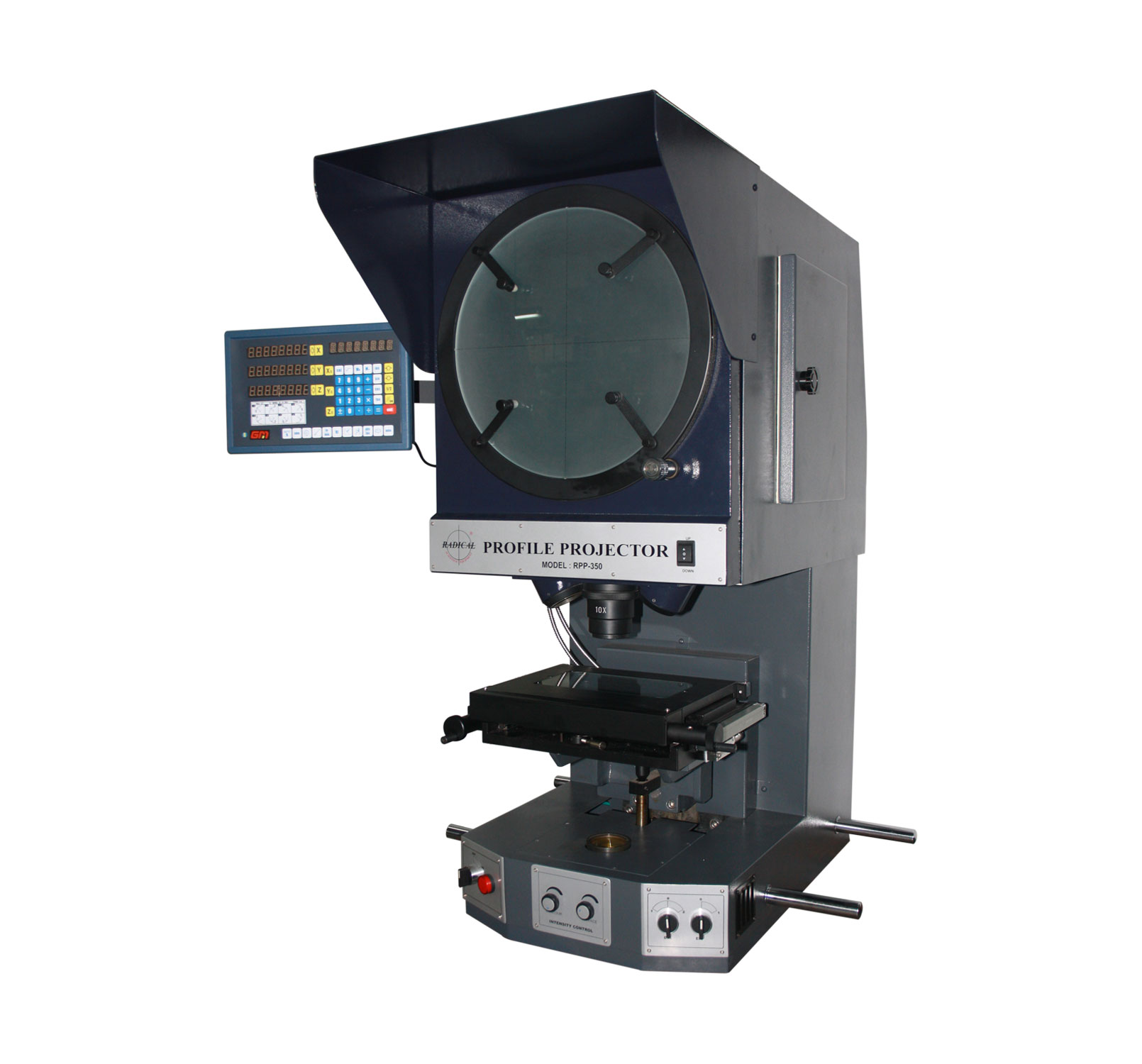
How Profile Projectors Improve Quality Control in Automotive Component Manufacturing
By Radical Scientific — Applications TeamPublished: 16 June 2026
Focus: A practical guide for quality engineers and production managers in automotive component manufacturing — covering why conventional gauging fails at production scale, how profile projectors (optical comparators) solve the core inspection challenges, and which applications benefit most from this technology.
India's automotive component manufacturing sector produces hundreds of millions of precision parts every year — stamped brackets, turned shafts, threaded fasteners, gear blanks, injection-moulded housings, and complex die-cast components. Every one of these parts requires dimensional verification before it leaves the production line. The difference between a quality control process that keeps pace with production and one that creates bottlenecks, escapes, and warranty claims often comes down to one question: is your inspection method fast enough, accurate enough, and practical enough for your floor operators to use reliably at volume?
The profile projector — also called an optical comparator — is the answer to that question for a large class of automotive inspection tasks. It has been on automotive production floors since the 1940s, and it remains the standard tool for contour inspection, thread gauging, gear tooth verification, and die profile check in Tier 1 and Tier 2 supplier quality labs across India's automotive manufacturing clusters.
What is a Profile Projector (Optical Comparator)?
A profile projector — also called an optical comparator or shadowgraph — is a non-contact optical measuring instrument that projects a magnified silhouette of a component onto a viewing screen, so the operator can measure dimensions and compare the part's profile against a reference drawing without touching it.
The component sits on the instrument's stage, and a light source directs a beam through or onto the part. The resulting shadow — magnified at a fixed ratio such as 10×, 20×, or 50× — is projected onto the screen. The operator reads dimensions directly using the digital readout (DRO) or checks the whole profile at once against a scaled overlay chart.
Vertical and Horizontal Configurations
Radical Scientific manufactures both configurations. In a vertical profile projector (RPP series), the optical beam runs vertically and the component rests flat on a horizontal glass stage — the standard setup for stamped sheet metal, moulded parts, and other flat or irregular components. In a horizontal profile projector (RPH-HDR series), the beam runs horizontally and the workpiece is held vertically in V-blocks or between centres — the configuration built for long cylindrical parts: threaded fasteners, turned shafts, hobs, and gear cutters.
Why the Optics Matter: Telecentric Projection
An ordinary lens introduces perspective distortion — a feature closer to the lens looks larger than an identical feature farther away. For measurement, that's unacceptable: the magnification has to stay constant no matter where the part sits on the stage. Radical Scientific's floor-standing RPP profile projectors are built on a vertical-beam, telecentric-zoom optical system specifically to eliminate this distortion, so the projected image stays true to scale across the full stage area.
Magnification accuracy is specified per model — your Radical Scientific applications engineer can confirm the exact figure for the configuration you're evaluating — but the practical result of telecentric projection is the same across the range: your overlay comparisons and DRO readings hold up regardless of where the component sits on the stage.
Profile Projector Parts and Their Functions
Understanding the main components helps operators set up correctly and keep measurements consistent across shifts.
Projection Screen
The frosted screen displays the magnified component shadow, marked with a reference crosshair and, on most models, a rotatable angle scale. Across the Radical Scientific range, screen sizes run from 250mm (RPP-250 benchtop) up to 600mm (RPP-60 floor-standing and the largest RPH-HDR horizontal model), with intermediate sizes at 350–360mm, 400mm, and 500mm depending on the model.
Projection Lens
The lens sets the magnification ratio. Standard magnification across the range is 10×, with 20×, 25×, 50×, and 100× available as optional lenses. The RPH-HDR horizontal series uses a 3-turret lens mount for fast, safe magnification changes; a turret mount is also available as an option on select RPP vertical models.
Work Stage (X-Y Stage)
The stage carries the component and moves in X and Y, with travel and table size varying by model. As reference points: the RPP-500V floor-standing model has a 350×200mm work stage with 150×100mm X-Y travel, while the RPH-HDR horizontal series ranges from a 400×150mm table with 200×150mm travel on the 300mm-screen model up to a 600×250mm table with 300×250mm travel on the 600mm-screen model.
Digital Readout (DRO) and Measuring Unit
Resolution depends on the model configuration. The DR, DP, and DM variants of the RPP series, the RPP-500V, and the full RPH-HDR range measure to 0.001mm (1 micron) using digital linear scales. Base RPP-60/250/350 models ship standard with mechanical micrometer heads reading to 0.01mm, with the finer digital option available as an upgrade. Higher-specification models add a geometric Data Processor, and select models (RPP-500V, RPP-60DP) offer optional PC-based (M2D) software for calculating distance, circle, angle, and other geometric elements directly from measured points.
Illumination System
Most RPP models offer two illumination modes (confirm which are fitted as standard on your specific model):
Contour (transmitted) illumination — a 24V/150W halogen lamp with a built-in condenser system lights the part from below, casting a sharp silhouette. This is the standard mode for metal components and most dimensional measurement.
Surface (EPI) illumination — an LED or 12V/100W halogen source lights the component from above for surface inspection of opaque parts, such as plastic mouldings, where a transmitted shadow doesn't give a usable edge.
Fixtures and Workholding
Common accessories across most of the Radical Scientific RPP and RPH-HDR range include the overlay chart, V-block with clamp, swivel centre support, edge detector, foot switch, holder with clamp, and precision fixtures — covering typical workholding needs for stamped parts, turned shafts, and gear/thread components. Availability varies by model, so confirm the accessory list for your chosen configuration when requesting a quote.
How to Measure with a Profile Projector
The four measurement tasks below cover most automotive and precision-component inspection work on Radical Scientific RPP vertical and RPH-HDR horizontal profile projectors.
How to Measure Length or Width
Place the component on the stage and adjust focus until the projected image is sharp on the screen.
If your projector has a rotary stage, rotate it to align the edge you want to measure with the screen's reference line.
Traverse the stage until the reference line bisects the first edge of the feature. Zero the DRO (or micrometer head) in that axis.
Traverse to the opposite edge and read the value directly.
Tip for stamped parts: Zero at one common datum edge and measure every feature from that single reference — it removes cumulative positioning error and gives you data you can use directly for PPAP documentation.
How to Measure Radius or Diameter
Focus the component on the stage.
For radius: align the centre of the circular feature with the screen crosshair, zero both axes, then traverse to the edge — the DRO reading is the radius.
For diameter: zero at one edge, traverse to the opposite edge, and read the displacement. Repeat in a perpendicular direction to check roundness.
On models fitted with a Data Processor, three edge points around the circumference give an automatic best-fit circle diameter and centre position.
How to Measure Angles
Three methods, depending on your instrument:
Rotary stage reading — rotate the stage until the feature edge aligns with the screen's horizontal reference line and read the graduation directly. Resolution varies by model — 1 arc-minute on the larger RPP vertical models (RPP-60, RPP-350, RPP-500V), 6 arc-minutes on the compact RPP-250, and 2 arc-minutes on the RPH-HDR horizontal series.
Overlay (protractor) chart — a radial-line overlay chart mounted on the screen; align the feature edge to the nearest graduation.
DRO/Data Processor calculation — on models with a geometric Data Processor, mark two points on a straight edge by traversing to each and recording the coordinates; the angle is calculated automatically.
How to Use Overlay Charts for Profile Comparison
Overlay comparison lets you check a component's entire contour against its drawing geometry in one view, instead of measuring feature by feature.
The overlay chart is a scaled printout of the nominal profile at your working magnification — at 10×, a 5mm drawing feature prints at 50mm on the chart. The overlay chart is available as an accessory on most models in the RPP and RPH-HDR range; for a chart specific to your component, produce it from the component drawing at the correct magnification, or speak to your Radical Scientific applications engineer for chart preparation support.
Mount the overlay chart on the screen, aligning its datum to the screen crosshair.
Place the component on the stage and focus.
Traverse the stage to align the projected image datum to the overlay datum.
Check the projected profile against the overlay tolerance band — anything outside the boundary is an out-of-tolerance deviation.
Use the DRO to quantify any deviation you find.
The dimensional inspection challenge in automotive manufacturing
Automotive component quality control operates under constraints that most other manufacturing sectors do not face at the same scale:
High volume, tight tolerances
A typical Tier 1 stamping supplier may produce 50,000 to 500,000 identical components per shift. Each component has multiple dimensional features — length, width, profile, radius, hole position, flange angle — that must conform to drawing tolerances typically in the range of ±0.05 mm to ±0.2 mm. Inspecting every part with a hand micrometer or vernier caliper is physically impossible. Sampling inspection must be fast, reliable, and traceable.
Complex contour profiles
Many automotive stamped, formed, and moulded components have complex non-linear contour profiles — curved flanges, radiused pockets, profiled cut-outs, formed channels — that cannot be measured meaningfully with a single-point gauging instrument. A vernier caliper gives you a length. It tells you nothing about whether a formed radius is within tolerance, whether a punch profile has worn beyond its limit, or whether a moulded flange matches the design curve.
Thread and gear inspection volume
Fastener manufacturers, gear box component suppliers, and hob cutters face a specific challenge: verifying thread form (flank angle, pitch, root radius, crest geometry) and gear tooth profile on every production batch. Thread gauges confirm go/no-go. They do not give you the thread form data needed to diagnose a worn die or detect a systematic process drift before it produces rejects.
Die and punch wear monitoring
In stamping and forming operations, the die and punch wear over time. The profile of the punch directly determines the profile of the stamped part. Monitoring die wear requires comparing the punch profile against the nominal drawing geometry at regular intervals — something that cannot be done quickly with manual gauging but is straightforward on a profile projector with an overlay chart.
The escape cost: A dimensional non-conformance that escapes the supplier and reaches the OEM assembly line is 10–100× more expensive to correct than one caught at the supplier's incoming inspection or in-process QC stage. The investment in a profile projector is consistently justified by a reduction in escape rate alone.
Why profile projectors solve these problems
A profile projector addresses every one of the above challenges directly, through a combination of non-contact measurement, visual overlay comparison, and fast operator workflow.
Full contour inspection in seconds
The profile projector projects an enlarged silhouette of the component — magnified 10×, 20×, or 50× — onto a large viewing screen (300 mm to 600 mm diameter). The operator can see the entire component profile in a single view. Using a scaled overlay chart printed with the nominal profile, the operator immediately sees any deviation between the actual part and the drawing geometry. What would take minutes with calipers and angle gauges takes under 30 seconds on a profile projector, with far more information about the full profile shape.
No operator calculation required
The profile projector's overlay comparison method is a direct visual go/no-go decision. The operator does not calculate tolerances, does not interpret a dial reading, and does not risk arithmetic errors. The projected image either fits within the overlay limits or it does not. This makes the inspection process fast, reliable, and far less dependent on operator skill level — critical in production environments where multiple shift workers operate the same inspection station.
0.001 mm DRO for feature measurement
When specific dimensional values are needed — for first article inspection, PPAP documentation, or SPC data entry — the profile projector's digital readout (DRO) measures stage displacement to 0.001 mm resolution. The operator positions the screen's reference crosshair on a part edge, zeros the DRO, then traverses to the opposite edge and reads the dimension directly. No calculation, no parallax error, no contact with the part.
Non-contact — no part deformation or contamination
Automotive components often arrive at the inspection station with cutting oil, pressing lubricant, or surface treatments that must not be disturbed. A profile projector measures by projecting light — there is zero contact with the part surface. Delicate parts are not deformed by gauge pressure. Soft materials are not marked by probe tips. Oiled surfaces do not need to be cleaned before measurement.
The 5 most important profile projector applications in automotive QC
1. Stamped and formed sheet metal components
Sheet metal stampings — brackets, clips, flanges, reinforcements, formed channels — are the highest-volume application for vertical profile projectors in the automotive supply chain. The component is placed flat on the horizontal work stage. The profile projector projects its silhouette at 10× or 20× magnification. The operator checks the flange profile, hole geometry, formed radius, and cut-out shape against the overlay chart in a single view. Batch sampling of 50+ components per hour is routine for experienced operators on a production floor profile projector station.
Critical dimensions that are verified: flange angle and straightness, corner radius, hole diameter and position, profiled cut-out geometry, edge burr assessment.
2. Threaded fasteners and machined screw threads
Thread form inspection is one of the oldest and most reliable applications of the horizontal profile projector. The workpiece — a bolt, stud, screw, or threaded shaft — is held horizontally in V-blocks or between centres on the work stage. The profile projector projects the thread form at 25× or 50× magnification. The operator measures or overlay-compares: thread flank angle (left and right), pitch, root radius, crest form, and thread height. Standard metric, UNC, BSW, and ACME thread overlay charts are used directly at the appropriate magnification.
This inspection identifies systematic thread form errors from worn taps or dies before they reach assembly — a key input for process control in fastener manufacturing and precision turned part production.
3. Gear and hob tooth profiles
Gear tooth form verification — involute profile check, pressure angle measurement, tip and root radius — is performed on a horizontal profile projector with the gear held on an arbor in the work stage V-blocks. The magnified tooth profile is compared against the nominal involute overlay at the appropriate pressure angle (typically 20° for automotive gears). Hobs, gear cutters, and form tools used to produce gears are inspected the same way, making the profile projector both a product inspection tool and a tooling condition monitor.
For gear blanks and ring gears produced in high volume, profile projector inspection during initial setup and at defined batch intervals catches geometry drift from tool wear before it propagates across the production run.
4. Die and punch profile verification
In stamping and blanking operations, the profile of the punch and die directly determines the profile of every component produced. As the tooling wears, dimensions drift — often gradually enough that no individual component fails dramatically, but the systematic drift accumulates until a batch fails final inspection at the OEM. Profile projector inspection of the punch profile at scheduled maintenance intervals catches wear before it causes a quality escape. The punch is placed on the vertical stage, projected at 10× or 20×, and the profile is compared against a nominal overlay. Wear at the cutting radius, punch angle changes, and edge chip-out are all visible immediately.
5. Injection moulded and die-cast profiles
Plastic injection moulded and aluminium die-cast components — housings, brackets, clips, connector bodies — have complex 3D profiles with formed features, draft angles, ribs, and snap-fit geometries. While a profile projector inspects the 2D cross-sectional profile rather than the full 3D geometry, critical cross-sections selected from the part drawing cover the majority of dimensional risk for most moulded components. The surface (reflected) illumination mode on the profile projector allows inspection of opaque moulded surfaces without the contour (transmitted) illumination required for metal stampings.
Profile Projector Applications Beyond Automotive: Rubber, Plastic, and Precision Components
The same instruments used for automotive stampings and threads also serve rubber, plastic, and precision turned components — a common secondary use case in Indian manufacturing.
Rubber and Elastomeric Components
Rubber seals, O-rings, gaskets, and moulded bushings deform under contact — a micrometer or caliper jaw pressed onto a soft profile compresses it and gives an inaccurate reading. Because a profile projector measures by projecting light, with no contact at all, it captures the true unloaded geometry of the part.
For O-ring and small seal cross-sections, a vertical benchtop profile projector is the more practical setup — the part or cut section rests flat on the stage without special fixturing. Larger elastomeric profiles and extruded rubber sections can be measured the same way, checking cross-section shape at defined intervals.
Plastic Injection Moulded Components
Connector bodies, clips, and bracket housings drift in dimension as mould tooling wears. Checking moulded cross-sections at intervals on a profile projector catches that drift before it produces non-conforming batches. Transparent or translucent plastics can often be checked in transmitted (contour) mode for a clean silhouette; opaque plastics need the surface (EPI) illumination mode, available on most RPP models, to project surface features from above.
Precision Turned Components
Small turned parts — bushings, valve spools, nozzles — are well suited to the RPH-HDR horizontal series, where the part is held between centres or in a V-block, matching the same setup used for threaded fasteners and turned shafts. The magnified profile reveals taper errors, radius blends, and chamfer angles that a single-point probe would miss.
Choosing the right profile projector for your automotive QC lab
The correct profile projector for an automotive quality lab depends on the types of components you inspect, the production volume, and the floor space available. The two primary decisions are configuration (vertical vs horizontal) and screen size.
Component Type
Recommended Configuration
Screen Size
Typical Magnification
Stamped sheet metal, brackets, clips
Vertical (floor-standing or benchtop)
400–600 mm
10×, 20×
Threaded fasteners, turned shafts
Horizontal
300–500 mm
25×, 50×
Gear tooth profiles, hob cutters
Horizontal
400–600 mm
20×, 50×
Punches, dies, form tools
Vertical (benchtop)
300–400 mm
10×, 20×
Moulded plastic, die-cast parts
Vertical with surface illumination
300–500 mm
10×, 20×
Mixed production floor (all types)
Vertical floor-standing + horizontal
500–600 mm
10×, 20×, 50×
Production Floor Setup Tip: In a high-volume automotive supplier quality lab, two profile projectors positioned side-by-side — one vertical for stampings and mouldings, one horizontal for threads and turned parts — cover the full component range without instrument changeover delays. Both instruments share the same DRO data export for SPC reporting. The combined investment is significantly less than a single CMM and provides far greater throughput for 2D inspection tasks.
Floor-standing vs benchtop for stamped components
A floor-standing vertical profile projector (500 mm or 600 mm screen) is the standard choice for production-floor automotive QC when components are larger than approximately 40 mm cross-section, when stage travel exceeding 200×150 mm is required, or when continuous heavy-duty use demands a more robust instrument frame. Benchtop models (300 mm or 400 mm screen) are appropriate for inspection cells inspecting smaller components — small stampings, precision turned parts, and electronic connector components — where floor space is limited and component size permits a smaller screen.
DRO and data output for PPAP and SPC
For automotive suppliers operating under IATF 16949 or customer-specific quality requirements, the profile projector's DRO should provide PC data output (RS-232 or USB) to feed dimensional data directly into SPC software. First article inspection (FAI) and PPAP documentation require recorded measurement values with calibration traceability. Confirm that the profile projector supplier provides a calibration certificate traceable to NABL/NPL national standards at the time of delivery — this is a mandatory audit requirement for most automotive OEM supplier qualification processes.
Setting up an efficient inspection workflow on the production floor
Overlay chart preparation
The most important preparation step is producing accurate overlay charts at the correct magnification for each component. An overlay chart is a transparent film printout of the nominal component profile at the projector's magnification scale (e.g., at 10×, the overlay is drawn at 10:1 scale). The overlay is mounted on the screen using the locating ring. The operator places the component on the stage, aligns the projected image to the overlay reference datum, and checks the full profile in one view. Overlay charts for all regular production components should be prepared, stored in labelled files, and calibrated as part of the gauge management system.
Operator training and standard work
Profile projector operation at production level requires training in: stage loading and workpiece fixturing, overlay chart mounting and datum alignment, DRO zeroing and incremental measurement, and recording of out-of-tolerance findings. A trained operator can perform a complete 10-feature dimensional check on a stamped component in under 2 minutes — fast enough to maintain 30-minute sampling intervals on most production lines without creating an inspection bottleneck.
Gauge R&R for profile projectors
Profile projectors used in IATF 16949 environments should be included in the Gauge Repeatability and Reproducibility (GR&R) study programme. The DRO measurement function is straightforward to include in GR&R studies. Overlay chart comparison — being a visual go/no-go method — is typically handled as an attribute gauge study. Annual calibration of the magnification accuracy and stage displacement accuracy by the instrument manufacturer or a NABL-accredited calibration lab is required for traceability documentation.
Profile Projector Maintenance, Calibration, and Care
Regular maintenance and calibration keep measurement accuracy from drifting unnoticed — the instrument will keep producing readings even as they quietly diverge from true values, so scheduled care matters.
Routine Maintenance
Lens cleaning: clean the projection lens periodically with lens tissue and optical cleaning solution — oil mist and handling contamination reduce contrast and edge sharpness. Never use abrasive cloths on optical surfaces.
Stage lubrication: the X-Y stage lead screws need periodic lubrication per the service schedule in your instrument manual — binding or rough movement affects repeatability.
Screen cleaning: keep the screen free of fingerprints and dust, which reduce contrast and make edge judgement unreliable.
Lamp replacement: when contrast noticeably drops, the halogen lamp (standard on all models) or LED source (available as an alternative on several RPP models) needs replacing. LED sources have a longer service life than halogen.
Calibration Requirements
Magnification accuracy: verified with a calibrated glass reticle on the stage, comparing the projected scale to nominal. Rated accuracy is specified per model — confirm the figure for your exact configuration in the calibration certificate supplied with the instrument.
Stage displacement accuracy: verified using a precision reference standard traversed across the stage, checked against the DRO or micrometer head reading.
Calibration interval: for IATF 16949 environments, 6 to 12 months is typical depending on usage and tolerance requirements. Radical Scientific provides an in-house calibration certificate with every instrument at delivery, and our NABL accredited laboratory handles recalibration.
Profile projectors from Radical Scientific for automotive applications
Radical Scientific Equipments Pvt. Ltd. has manufactured profile projectors and optical comparators since 1975. We supply instruments to quality labs and manufacturing facilities across India, with offices and service support in Ambala, Delhi, Chandigarh, Mumbai, Chennai, Rajkot, Kolkata, and Kerala.
Our range covers all configurations used in automotive quality control:
Vertical Profile Projectors — RPP series, floor-standing and benchtop, 300–600 mm screen. Standard for stamped component and moulded part inspection on the production floor.
Horizontal Profile Projectors — RPH-HDR series, 300–600 mm screen. Designed for thread form, gear tooth, and hob profile inspection.
Benchtop Profile Projectors — compact 300–400 mm models for tool room, incoming inspection, and small-component QC cells.
All models are available with NABL-traceable calibration certificates and after-sales service support across India's major industrial centres.
Frequently Asked Questions
Can a profile projector inspect all types of automotive components?
A profile projector is optimised for 2D cross-sectional profile inspection — it inspects the profile of a component as seen in projection, not its full 3D geometry. For stamped sheet metal, threaded fasteners, gear teeth, and tool profiles, this 2D inspection covers the critical dimensional features. For complex 3D components where position and form in three axes must be simultaneously verified, a CMM is the appropriate instrument. Most automotive quality labs use both: a profile projector for fast, high-throughput 2D inspection and a CMM for first-article and PPAP measurement tasks.
How fast is profile projector inspection compared to manual gauging?
On a profile projector with prepared overlay charts, a trained operator can typically inspect a stamped component covering 8–12 dimensional features in a fraction of the time required with manual gauging. The same inspection using individual instruments — micrometer, radius gauge, angle gauge, vernier — requires significantly more time per component and demands a higher level of operator skill to achieve comparable accuracy. Across multiple shifts, the productivity difference is substantial, particularly for inspection cells running high sampling frequencies.
What is the accuracy of a profile projector for automotive component inspection?
A calibrated profile projector with telecentric optics achieves dimensional measurement accuracy of ±0.001 mm to ±0.005 mm using the DRO stage measurement function. Magnification accuracy for overlay comparison is specified per model and screen size — your Radical Scientific applications engineer can confirm the exact figure for your configuration. For most automotive inspection tolerances (±0.05 mm and above), profile projector accuracy is more than adequate. For tolerances tighter than ±0.02 mm, a CMM or vision measuring system should be considered.
Does a profile projector need to be NABL calibrated for IATF 16949 compliance?
Yes. For use in an IATF 16949-certified quality system, all measurement instruments including profile projectors must be calibrated on a defined schedule with calibration certificates traceable to national measurement standards (NABL in India, NPL nationally). Radical Scientific provides NABL-traceable calibration certificates with all profile projectors at the time of delivery. Recalibration service is available through our in-house NABL accredited laboratory — contact us to arrange.
Which profile projector screen size is right for automotive stamped parts?
The screen size should be selected based on the largest component cross-section you need to inspect at your standard working magnification (usually 10×). At 10×, a 400 mm screen covers a component cross-section of approximately 35–38 mm. A 500 mm screen covers approximately 45–48 mm. A 600 mm screen covers approximately 55–58 mm. Choose the screen size that covers your largest typical component with a 15–20% margin for positioning flexibility. If your stamped components range up to 100 mm cross-section, a 600 mm screen is the appropriate choice. When requesting a quotation from any profile projector manufacturer, share your component drawing and largest cross-section dimension — a reputable supplier will recommend the correct screen size and magnification configuration before you commit to a purchase.
What measurements can a profile projector perform?
A profile projector measures linear dimensions (length, width, height, step), diameters, radii, angles, pitch, and full contour profiles compared against an overlay chart. Models fitted with a geometric Data Processor add derived measurements — best-fit circle diameter, angle from two points, and similar calculations — directly from measured points. The instrument measures 2D profile, not full 3D form across three axes; for that, a CMM is the right tool.
How does a profile projector inspect rubber parts without damaging them?
Measurement is entirely non-contact — the instrument projects a light silhouette of the part, with no probe or jaw touching the surface. For rubber seals, O-rings, and elastomeric profiles, this means the projected image shows the true, unloaded geometry of the part. For small ring or seal cross-sections, a vertical benchtop profile projector is the practical choice — the part or a cut section rests flat on the stage.
What is the difference between a profile projector and an optical comparator?
They are the same instrument. "Optical comparator" is the more common term in North America; "profile projector" is the preferred term across India, Europe, and East Asia. Both describe the same measurement principle — projecting a magnified image of a component for comparison and measurement.
What does a profile projector's optical path look like?
The optical path runs from the light source through (or onto) the component, through the projection lens, and onto the screen. In a vertical profile projector, this path runs upward, with the component resting flat on a horizontal stage below the optical column. In a horizontal profile projector, the path runs sideways, with the component held vertically in V-blocks or between centres. Both configurations use the same principle — the projection lens keeps magnification constant regardless of where the feature sits within the stage's focus range.
Can a profile projector measure angles accurately?
Yes, through three methods: reading the rotary stage graduation directly, using a protractor-style overlay chart, or — on models with a Data Processor — calculating the angle from two measured points. Rotary stage resolution varies by model: 1 arc-minute on the larger RPP vertical models, 6 arc-minutes on the compact RPP-250, and 2 arc-minutes on the RPH-HDR horizontal series.
What magnification should I use for profile projector inspection?
It depends on component size and the smallest feature you need to resolve. 10× is the standard magnification across the range and covers most stampings, brackets, and moulded housings. 20× suits smaller stampings and precision turned parts. 25× and 50× are standard for thread and gear-tooth inspection. As a rule of thumb, choose the magnification that fills 60–70% of the screen with your feature of interest.